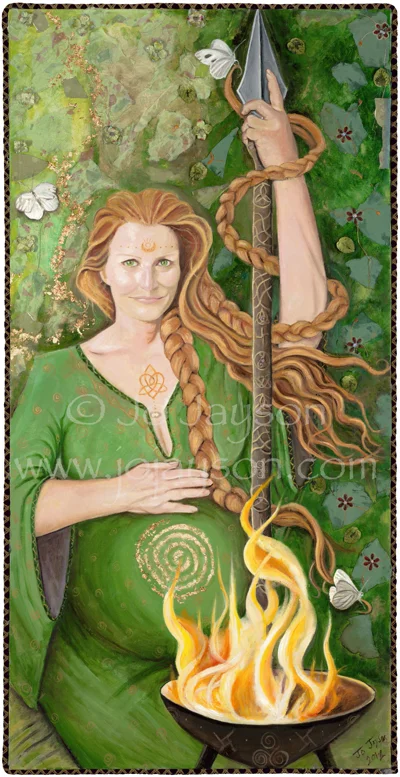
© Jo Jayson 2012
I have been here before. A thousand thousand times before.
You can call me Brighid. I am an amalgam—the Celtic goddess of fertility, the wise village nana, the midwives and doulas who caught your babies and stayed to see you through, every woman who held this knowledge before the medical journals existed. I channel the wisdom of ages, filtered through what modern science now confirms. I am not one voice but many, speaking as one.
I was the grandmother who noticed when your bleeding changed, who made you tea and told you what to expect. I was the midwife who stayed after the birth, who saw you through every passage of your womanhood. I was the village healer who knew which herbs to gather when you couldn’t sleep, when your moods swung wild, when the heat rose in you like summer lightning.
I have sat with women in stone huts and apartment buildings, in yurts and farmhouses and hospital rooms. I have watched you navigate this crossing in every century, in every corner of the world. And I have learned—from every woman I’ve attended, from every doctor who carries this knowledge now, from every researcher piecing together what your body already knows.
I write this because I see you struggling. I see you frightened by changes you don’t understand, dismissed by providers who should know better, wondering if you’re losing your mind when your body is simply doing what bodies do. I see you scrolling at 3 AM, finding contradictions and fear-mongering instead of understanding. I see you suffering in silence because no one told you this was coming, or what it would feel like, or that it’s real.
It's real. All of it. What you're feeling is not in your head.Santoro N, et al. Perimenopause: From Research to Practice. Journal of Women's Health. 2016;25(4):332-339.What This Guide Is
This is the conversation I wish your mother had with you. The one her mother should have had with her. The knowledge that got lost somewhere between the village wise woman and the seven-minute doctor’s appointment.
I’ll explain what’s actually happening in your body—not in medical jargon that makes you feel small, but in plain words that make the chaos make sense. I’ll tell you about the remedies women have used across cultures and centuries, because that knowledge matters. And I’ll share what modern science has discovered, because that matters too.
I hold no allegiance to “natural” versus “medical.” I’ve seen sage tea help one woman and fail another. I’ve seen estrogen transform lives and cause suffering in equal measure. What works is what works for you—and the only way to know is to understand your options and pay attention to your own body.
Your body knows things. It has always known things. My job is to help you understand its language again.
What Perimenopause Actually Is
Let me be clear about something most sources get wrong: perimenopause is not a gentle decline. It’s not your hormones slowly fading like a sunset.
It's chaos.Harlow SD, et al. Executive Summary of the Stages of Reproductive Aging Workshop +10. Menopause. 2012;19(4):387-395.Your estrogen doesn’t politely decrease. It swings—sometimes higher than it’s ever been, sometimes crashing to nearly nothing, sometimes changing dramatically within a single week.Prior JC. Perimenopause: The Complex Endocrinology of the Menopausal Transition. Endocrine Reviews. 1998;19(4):397-428. Your progesterone drops because you’re not ovulating reliably anymore. And your brain, which has been listening to these hormones for decades, suddenly can’t predict what’s coming next.
This is why your symptoms seem random. Why one month you feel fine and the next you’re a stranger to yourself. Why sleep abandons you, or your joints ache, or your skin changes, or desire vanishes, or your moods swing wild. It’s not weakness. It’s not age. It’s your brain trying to find its footing on shifting ground.
For most women, this transition begins somewhere in the 40s and lasts four to ten years.Sowers M, et al. SWAN: A Multicenter, Multiethnic, Community-Based Cohort Study of Women and the Menopausal Transition. Menopause: Biology and Pathobiology. Academic Press, 2000. Some sail through barely noticing. Others are knocked flat. Most are somewhere in between, with good stretches and hard ones, figuring it out as they go.There is no “normal” experience. There is only your experience.
Why Every Body Is Different
You’ll hear this phrase everywhere: “every body is different.” It can feel like a dismissal—a way to avoid giving you real answers.
But it’s not a cop-out. It’s biology.
Your experience of perimenopause depends on your unique combination of:Gold EB. The Timing of the Age at Which Natural Menopause Occurs. Obstetrics and Gynecology Clinics of North America. 2011;38(3):425-440.- Your baseline hormone levels and sensitivity
- Your brain’s particular receptor patterns
- Your stress history and cortisol patterns
- Your gut microbiome (yes, really—it affects how you process hormones)
- Your genetics, including your mother’s experience
- Your overall health, sleep, movement, nutrition
- What else is happening in your life
This is why the same intervention helps one woman profoundly and does nothing for another. It’s not that one of you is wrong—it’s that you’re different people, with different biology, navigating the same passage in your own way.
A Word About Evidence
I value what science has learned. The careful work of researchers—many of them women who fought to be taken seriously—has given us knowledge that saves lives and reduces suffering. I’ll share that evidence clearly, including when it’s strong, when it’s limited, and when we simply don’t know yet.
But I also carry knowledge that doesn’t fit neatly into clinical trials. The sage tea your great-grandmother swore by. The Chinese medicine formula that’s been refined over centuries. The way movement and breath and ritual can settle a nervous system. These deserve more than dismissal, even when the randomized controlled trials haven’t caught up.
I’ll tell you what the research shows. I’ll also tell you what women have done, and why it might matter. You can weigh both.
A Note on “Fixing” Perimenopause
You’ll notice this guide talks about “support” rather than “treatment.” That’s deliberate. Perimenopause isn’t a disease. It’s a passage—one that can be difficult, certainly, but not something broken in you that needs fixing. The options here are tools you might choose to use, or not, based on your own experience and values.
You’re Not Alone
Right now, millions of women are navigating this same passage. Your mother did, and her mother, and every woman in your lineage stretching back through time. They made it through. So will you.
The difference is that you don’t have to do it in silence, or confusion, or without understanding. The knowledge is here. The support exists. And across whatever distance separates us, I am sitting with you now, as I have always sat with women crossing this threshold.
Come. Let me tell you what I know.